The Top 10 Factors to Consider When Choosing a Car Wash Site

The Top 10 Factors to Consider When Choosing a Car Wash Site

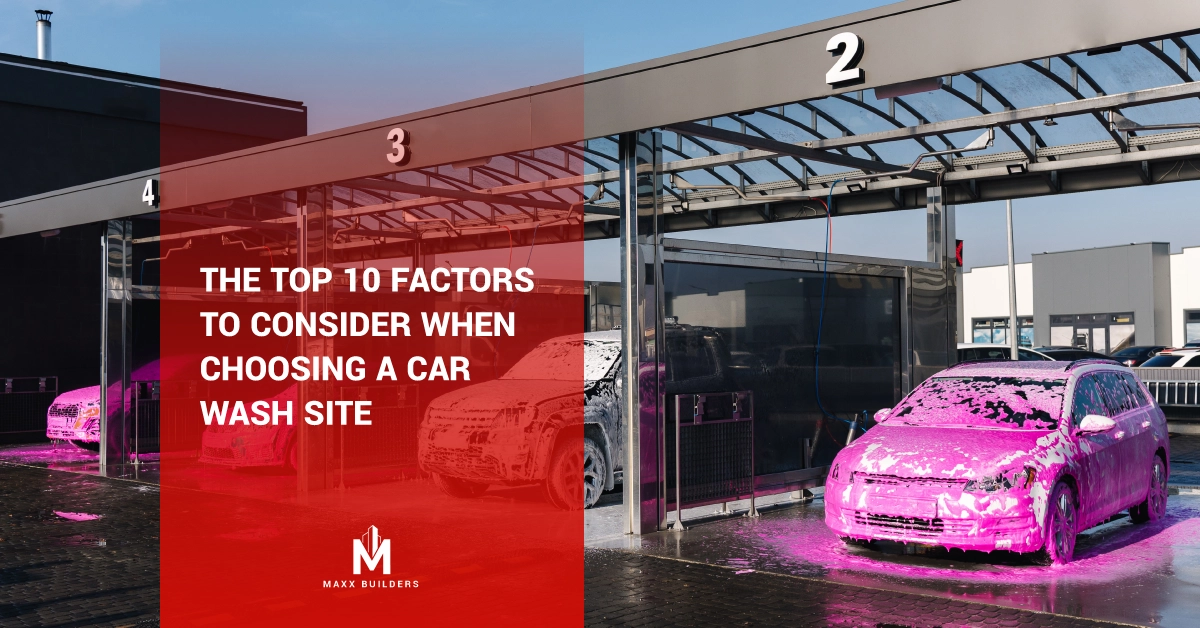
When it comes to choosing a location for a new car wash as an investor, securing an A+ property is crucial for success. As a location-driven service business, here are ten important factors to consider when selecting a car wash site:

1. Demographics

Check the current demographics of the surrounding area, including the number of vehicles, average and median income, and population breakdown.

2. Zoning

Make sure the property is zoned for business use to avoid the hassle of getting it rezoned.

3. Property Size

For a tunnel car wash, aim for an acre-sized property with at least 225 feet in one direction. The largest side of the property should face the road for maximum visibility.

4. Available Space

Allocate space for vacuum pads, queuing land, turning radiuses, and finishing areas.

5. Visibility

Ensure the car wash is visible from the main road for better exposure.

6. Traffic Counts

Although important, traffic counts are secondary to demographics.

7. Traffic Speed

A speed limit of less than 45 MPH is optimal for maximum exposure.

8. Nearby Retail Area

Placing the car wash near other retail businesses can provide an additional draw.

9. Nearby Competition

Avoid placing the car wash within three miles of competing car washes.

10. Property Cost

Take the cost of the property into account as part of your total investment or monthly operational expense.

While these are not the only factors to consider, they are some of the most important. Don’t skimp on finding the right property, as securing an excellent site is critical to the success of your car wash business.
How Maxx Builders Approaches Commercial Construction in Texas

Every commercial construction project in Texas turns on three early decisions: delivery method, cost predictability, and schedule realism. Maxx Builders engages on all three before contract signing on most design-build engagements — and this is where the largest cost variance in a project is locked in or avoided.

On delivery method: design-build aligns design and construction teams under one contract, eliminating the design-bid-build friction where architects and contractors negotiate scope late in the project. For most Texas commercial projects under $20M, design-build delivers faster schedules and fewer change orders. Construction management at-risk (CMAR) becomes preferable on larger or more complex projects where owner control over design choices is paramount.

On cost predictability: a credible preconstruction estimate at programming or schematic design — before construction documents are finalized — gives the owner real visibility into what the building will actually cost. The cost benchmarks throughout this guide draw on RSMeans 2025, Gordian Q1 2025 cost report, and validation against actual delivered-project costs across our Texas portfolio. (RSMeans, Gordian, 2025)

On schedule realism: most schedule failures originate in the first 30 days — incomplete permit packages, late finalization of finish selections, long-lead material decisions deferred. We pull schedule risk forward by sequencing critical-path items during preconstruction.

Maxx Builders has delivered across hospitality, healthcare, retail, industrial, and tenant improvement throughout Texas. If you’re evaluating a project in the planning or schematic phase, request a preconstruction consultation — that’s the window where decisions actually move budget.

Texas Retail & Restaurant Construction Playbook

Retail and restaurant construction in Texas combines high-density tenant coordination, brand-prototype compliance, and the operational realities of front-of-house guest experience. Per-SF costs run $250–$575+ for retail and $250–$800+ for restaurants depending on cooking type, FF&E grade, and brand requirements (RSMeans 2025; JLL Retail Market Reports). Maxx Builders has delivered across the spectrum, including Y-Shops shopping centers, Shoe Palace, Minnonite Retail, Glazed Doughnut Cafe, Throwback Bar & Grill, and Middle Spoon.

Tenant Coordination

Retail shopping centers depend on signed anchor tenants for financing and have stage-gate dependencies. Construction can’t start until lease conditions are met; tenant CDs (their drawings for build-out) must align with landlord CDs (shell). Maxx Builders structures the coordination so anchor tenants get to occupancy on schedule and smaller tenants can start build-out without conflicts. (ICSC retail-development benchmarks)

Brand-Prototype Compliance

For franchise retailers (QSR chains, fitness, soft goods) and national hotel brands, the brand prototype book governs finishes, equipment, signage, layout, and even FOH/BOH separation. Brand approval gates at schematic, DD, and pre-construction prevent costly redesigns. Maxx Builders has managed brand approvals for Hilton, Hyatt, and IHG hotels, Anytime Fitness, Shoe Palace, and others.

Restaurant Specialty Items

Restaurants require coordinated grease trap sizing (TCEQ and Texas plumbing code), hood and exhaust systems with calculated makeup air, kitchen fire suppression (Ansul/wet chem), and health-department inspection sequence. Final health inspection requires all equipment installed and connected — driving FF&E delivery timing.

Texas Retail Submarkets in 2026

Most active Texas retail submarkets:

  • Houston: Katy/Cinco Ranch (suburban growth), Sugar Land/Stafford (corporate adjacent), The Woodlands (high-end), Energy Corridor (mixed-use redevelopment).
  • Dallas–Fort Worth: Frisco/Plano (high-growth retail), Las Colinas/Irving (corporate trade area), Fort Worth submarkets (suburban expansion).
  • Austin: The Domain corridor, South Lamar, East Austin (urban retail).
  • San Antonio: 1604/I-10 corridor (suburban), The Pearl District (urban).

Build-Out Phasing

Many retail and restaurant projects are tenant build-outs in existing landlord-provided shells. The phasing differs from ground-up:

  • Landlord coordination: verify base building condition matches what’s promised in lease.
  • Demolition (if reuse incomplete): selective demo of existing partitions, ceilings, MEP.
  • Rough-in: framing, MEP routing for tenant program.
  • Finishes: wall finishes, ceiling, flooring, casework, lighting.
  • Equipment installation: kitchen equipment, retail fixtures, FF&E.
  • Final inspections: building, fire, health (restaurants).

Typical retail TI runs 8–16 weeks; restaurant TI runs 12–20 weeks. Brand-specific concepts can run shorter (when prototype is mature) or longer (when custom).

Maxx Builders’ tenant improvement and retail construction services span the full lifecycle. Learn about our TI services or request a consultation.