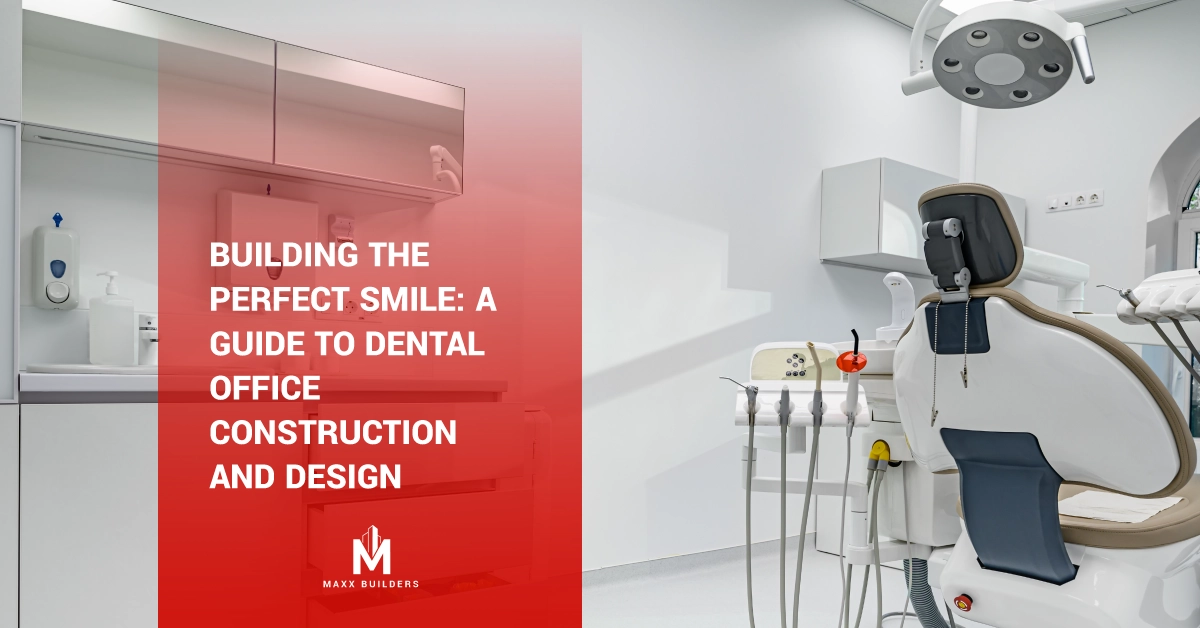
Building the Perfect Smile: A Guide to Dental Office Construction and Design

Building the Perfect Smile- A Guide to Dental Office Construction and Design

When it comes to designing and building a dental office, there are several factors to consider, including layout, functionality, and aesthetics. A well-designed dental office is not only essential for the comfort of the patients but also for the productivity of the dental team. In this article, we’ll discuss the essential aspects of dental office construction.

Layout and Functionality

The layout of a dental office should be carefully planned to ensure that it is functional and efficient. The design should make it easy for patients to move around and minimize the time they spend waiting. A well-planned layout will also allow the dental team to work more efficiently, making it easier to treat more patients in a shorter amount of time.

An ideal dental office should have a reception area, waiting area, treatment rooms, consultation rooms, and staff areas. The reception and waiting areas should be welcoming and comfortable to help patients feel relaxed. The treatment rooms should be well-equipped with the latest technology, and each room should have its own sink and ample storage space. The consultation rooms should be private and equipped with comfortable seating, allowing the dentist to discuss treatment plans with patients.

Technology

In today’s fast-paced world, technology is essential in a dental office. Dental equipment, such as X-ray machines, sterilizers, and digital scanners, should be state-of-the-art to ensure accurate diagnoses and effective treatment. Computer systems should be used to manage patient records, appointments, and billing.

Lighting and Color Scheme

Lighting is a crucial aspect of dental office design. The office should be well-lit, and natural light should be used whenever possible. The use of artificial lighting should be minimal, and it should be adjustable to suit the different tasks performed in each room.

The color scheme of the dental office should be carefully chosen to create a welcoming atmosphere. Neutral colors are often used, but a pop of color can be added to make the office more inviting. The colors used in the waiting area should be different from those used in the treatment rooms, as the waiting area should be calm and relaxing, while the treatment rooms should be bright and energetic.

Flooring and Walls

The flooring in a dental office should be durable, easy to clean, and slip-resistant. Carpeting should be avoided, as it can be difficult to clean and can harbor bacteria. Vinyl, laminate, or tile flooring is an excellent choice for a dental office.

The walls in the dental office should be easy to clean, durable, and preferably soundproof. The use of drywall is recommended, as it can be easily cleaned and painted. Wall panels can also be used to create a unique look in the office while providing sound insulation.

Compliance with Regulations

When constructing a dental office, it is essential to comply with local and state regulations. Building codes and zoning laws must be followed, and permits obtained where necessary. The office should also comply with OSHA regulations, ensuring the safety of the dental team and patients.

In conclusion, dental office construction requires careful planning and attention to detail. The layout and functionality of the office should be well-planned, and state-of-the-art technology should be used. Lighting, color scheme, flooring, and walls are essential aspects of dental office design. Finally, compliance with regulations is crucial to ensure the safety of the dental team and patients. By considering these essential factors, a well-designed dental office can be built, providing a comfortable and productive environment for both patients and dental professionals.

Contact us today to discuss your dental office design and construction needs, and we’ll be delighted to assist you.
Dental Office Construction: Specialty MEP & Code

Dental office construction sits at the intersection of healthcare and small-tenant TI — combining specialty MEP requirements that few GCs deeply understand with brand-conscious finish standards (dental groups care about patient-experience details that affect referrals). Dental construction in Texas typically runs $150–$400+ per SF for interior build-outs depending on equipment loading, lead-lined room count, and finish level. (RSMeans 2025)

  • Specialty MEP. Each dental operatory requires dedicated water lines, suction (central vacuum), compressed air, dedicated electrical circuits for chair and equipment. Compressed air and vacuum lines are typically central system (compressor + central vacuum pump in mechanical room). Plumbing routing must consider patient-experience (no exposed waste lines visible from chair).
  • Lead-lined imaging rooms. X-ray and panoramic imaging rooms require lead shielding on walls — typical 1/16″ or 1/8″ thickness depending on dose calculation by a radiation physicist. This is a code-driven requirement that must be sized during DD, not deferred to bid.
  • ADA & accessibility. Dental facilities serve patients with mobility limitations. Operatory chair clearances, restroom dimensions, and patient flow paths must meet ADA standards.
  • Sterilization & instrument flow. Sterile-to-clean-to-soiled flow paths between operatories and central sterilization. Affects layout, plumbing, and storage planning.
  • Office systems integration. Practice management software, imaging server, monitor mounting in operatories. Often dental-equipment vendor coordinates separately from GC — Maxx Builders coordinates both.

Maxx Builders has delivered dental office construction in Texas including Heartland Dental (Kyle, TX). Request a dental project consultation.

Specialty MEP & Code Coordination for Specialized Construction

Specialized commercial verticals — healthcare, dental, multi-family, and certain industrial uses — combine high-stakes MEP requirements with code-driven design standards. Maxx Builders has delivered specialty projects including Altus Healthcare (Houston, 15,000 sq ft interior build-out), Heartland Dental (Kyle, TX, dental practice), and Pearl Apartment (multi-family). The MEP and code coordination on these projects can dominate the project critical path if not managed from schematic forward.

Healthcare MEP Requirements

Healthcare facilities — particularly imaging, surgical, and procedural spaces — face additional MEP standards including:

  • Redundant electrical service for life-safety equipment (Joint Commission requirements where applicable)
  • Medical gas distribution — oxygen, nitrous, vacuum, scavenging (where dental/medical procedures occur)
  • Air handling separation for negative-pressure rooms (isolation, sterile processing)
  • Lead-lined imaging rooms for X-ray, CT, dental panoramic (1/16″ or 1/8″ lead depending on physicist calculation)
  • Compressed air and central vacuum for dental operatories — typical 1/2″ lines run from central mechanical room to each operatory
  • Sterile-to-soiled flow paths for instrument processing

Healthcare per-SF costs in Texas: $250–$800+ depending on level of care, finish grade, and MEP complexity (RSMeans 2025; CBRE U.S. Healthcare Capital Markets).

Dental Office MEP & Layout

Dental practice construction sits at the intersection of healthcare requirements and small-tenant TI. Each dental operatory needs:

  • Dedicated water lines (potable + amalgam separator return)
  • Central vacuum suction line (typical 1.5″ line)
  • Compressed air line (typically 1/2″)
  • Dedicated electrical circuits for chair, light, monitor, computer
  • Network connectivity (imaging server, practice management)
  • X-ray power outlet with proper grounding

Dental construction costs range $150–$400+ per SF for interior build-outs (RSMeans 2025). Maxx Builders has delivered Heartland Dental and other dental practice TIs in Texas.

Multi-Family Construction Considerations

Multi-family (apartments, condos, mixed-use residential) construction in Texas faces:

  • Unit-to-unit fire separation and STC (sound transmission class) ratings — often higher than code minimum to support lease rates
  • Sub-metering for individual unit utility billing
  • Common-area HVAC separation from unit HVAC
  • Trash and laundry chute routing in mid-rise/high-rise
  • Elevator coordination on 4+ story buildings
  • Pool, fitness, leasing-office FF&E as part of project scope

Texas multi-family permitting varies materially by jurisdiction. Maxx Builders has delivered multi-family including Pearl Apartment.

Code Coordination Practices

For specialty projects, code coordination should start before schematic design:

  • Pre-application meeting with city plan reviewer to identify special requirements early
  • Radiation physicist consultation for any imaging or radiation-bearing equipment
  • Fire marshal pre-review for high-occupancy or specialty use (e.g., assembly above 50 occupants)
  • Texas Health & Safety Code coordination for healthcare facilities
  • Texas TCEQ coordination for any chemical or biohazard handling (dental amalgam, medical waste)

Maxx Builders manages code coordination as part of preconstruction. Request a specialty project consultation.